Ravenloft
The Peculiar History of the Kingdom of Barovia, Part 2
Author's note, April 2026: Revised for accuracy after re-reading I10's primary material. The argument is unchanged.
The first part of this series established what I6 Ravenloft actually contains: a carefully constructed horror-tragedy whose central figure is not a condemned prisoner of dark powers but a man who sealed a land because he chose to, and who stays because everything that matters to him is there. It also established a question that I6 leaves open. The entity Strahd calls Death on the night of the murder is known only from his own account, and his account is unreliable. Something happened at that threshold. The conventional Ravenloft cosmology built an entire architecture of dark powers and condemned lords on top of it. I6 does not require any of that. What it requires is an explanation for what actually arrived when Strahd was dying, and that explanation is not in I6.
It is in I10.
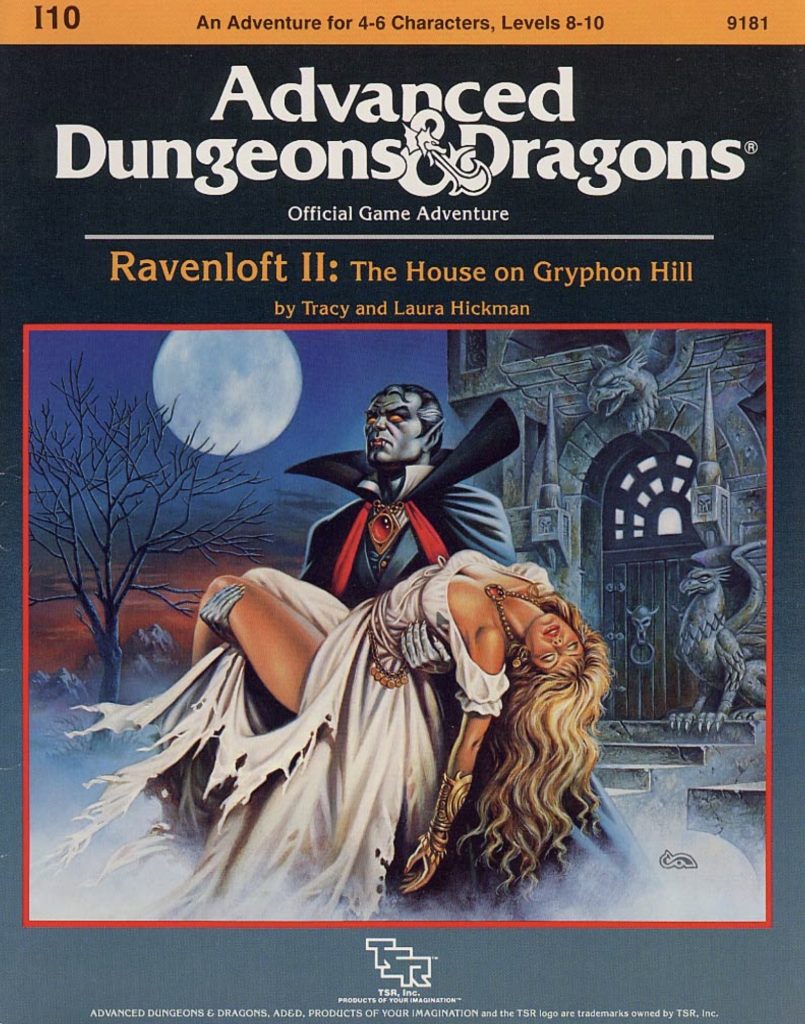
I10 Ravenloft II: The House on Gryphon Hill, written by a design team working from an outline by Tracy and Laura Hickman and published by TSR in 1986, is one of the least understood modules in the Ravenloft canon. It is routinely described as a sequel to I6, and this description creates problems that no one has satisfactorily resolved. The Strahd it presents is inconsistent with the Strahd of I6. The Alchemist it introduces is logically impossible as a split-off fragment of a vampire. The timeframes of the two adventures are, as the module itself acknowledges, miles and perhaps centuries apart. Reviewers have treated these as flaws. They are not flaws. They are the essay's evidence.
This piece proposes a reading of I10 that resolves these inconsistencies within a single framework. It does not require the module to be better written than it is, or more internally consistent than it manages to be. It requires only that the module be read carefully, including the passages most often overlooked: the Alchemist's Tale, the Creature's Tale, the Dreams of Barovia appendix, and the final line of the adventure. The first part of what follows is source analysis in the strict sense: examining what I10 actually contains and where the standard reading fails. The second part is speculative reconstruction, clearly identified as such throughout, proposing a reading that the module permits and that resolves what the source analysis identifies. Claims are separated throughout into what the sources establish, what they make plausible, and what remains inference. Where something is reconstruction, it is identified as such.
The Problem with the Sequel Reading
I6 establishes Strahd's character with unusual precision. Christie Golden's Vampire of the Mists, the most careful engagement with I6 in the subsequent canon, deepens that characterisation through Jander Sunstar's direct observation. The Strahd that emerges from those two sources is a man entirely settled in his dominion: intelligent, patient, cultivated, dangerous, and invested in Barovia in a way that spans centuries. He does not suffer for what he did. He rages at Ravenovia's tomb and weeps in Sergei's crypt, but these are the responses of a man whose attachments produce fury when denied or lost, not remorse for having destroyed them. He sealed his valley and has ruled it ever since. There is no suggestion in either source that he finds his condition intolerable, or that he has ever sought to escape it, or that he would consider purging the darkness from himself if such a thing were possible.
A sequel that presents Strahd as a man who built a machine to remove his own evil is therefore in immediate difficulty. The Strahd of I6 and VotM would not have done this. He is not a man tormented by his own darkness. He is a man who has made peace with it, on the worst possible terms, across four hundred years of consistent behaviour. The Alchemist's project is not something that Strahd would have conceived.
The second problem is simpler and perhaps more damaging. The Alchemist Strahd, as presented in I10, is a warm, living, breathing human being who has been in Mordentshire for a year, has fallen in love with Lady Virginia Weathermay, and is engaged to be married. He eats dinner at Heather House. He has rooms he has occupied for twelve months. He bleeds.
If the Alchemist is the good half of a vampire Strahd who split himself using the Apparatus, the body that remained after the evil was expelled was the body of an undead. Removing evil from a vampire does not restore the flesh to life. The undead state is not a spiritual condition overlaid on an otherwise intact human body. It is the body itself that is the problem. The Alchemist being alive has no mechanism under the sequel reading.
The third problem is the timeframe. I10 positions itself as taking place after the events of I6, with the Creature Strahd having crossed through a portal from Barovia following his defeat or the players' failure. But the Alchemist has been in Mordentshire for a year. He arrived from parts unknown, kept to himself, was eventually invited to dinner by Lord Weathermay, and fell in love with Virginia. This is not a man who materialised recently from a split performed in Barovia. He has a history in Mordentshire that predates the events of I6.
The module acknowledges all of this directly. The Dreams of Barovia appendix states that Barovia and Mordentshire are "miles and perhaps centuries apart." Not merely miles. Centuries. The module is telling the reader that the timeframes do not align. It offers three explanations: that Mordentshire is real and Barovia a fevered dream; that Barovia is real and Mordentshire not; or that both worlds are parallel and equally real. The third option is the one the sequel reading cannot accommodate. It is the option the evidence requires.
The Module's Own Ambiguity
Before examining the evidence in detail, the module's structure deserves attention, because I10 is unusual in the degree to which it builds uncertainty into its own foundations.
The dual narrative device is the most obvious instance. The module provides two in-character accounts of what happened, one from the Alchemist and one from the Creature. Both call themselves Strahd von Zarovich. The DM preamble at the head of the Ancient & Reborn section is blunter than any sequel reading can accommodate: "There are two in this play which each call themselves good and the other evil. Each answers to one another's name for both are called Strahd von Zarovich. Be not deceived!" The module goes on to instruct that each has his tale to tell in the face of the other's lies. This is not a device for concealing which account is correct. It is a device for establishing that both are simultaneously valid from their speaker's perspective, that lies are present on both sides, and that the question of which Strahd is the original cannot be resolved from within either narrative. The module is telling the DM, plainly, to read both tales critically.
The delirium mechanic reinforces this. Players arriving in Mordentshire suffer delirium episodes throughout the adventure. Those who have played I6 experience visions from Barovia. Those who have not experience visions of strange darkness. The delirium is described as a mystical property of the place, not a trick of the Creature and not a side effect of the Apparatus. It is the location itself that produces the visions. Something about Mordentshire generates a connection to events occurring elsewhere, across what the module calls a bridge.
The final line is "The End?" A question mark, not a full stop. The module does not know whether it is over. Or rather, it knows that from the perspective of one of its three valid interpretations, it is not over, because the other world is still there.
None of this is consistent with a module that has a definitive canonical answer about what is happening. I10 built its ambiguity deliberately. The reading that follows works with that ambiguity rather than against it.
The Architect
Neither the Alchemist nor the Creature is the original Strahd. The original Strahd is a third figure, the one whose soul is split when the Apparatus activates. Call him the Architect.
The Architect is a whole person, darkness and light in equal measure. He is not a saint in danger of corruption. He is not a monster suppressing his better nature. He is an ordinary person with an ordinary mixture of qualities, who did something. One act of darkness that cost him everything he would have been given had he been a dutiful son. The darkness was there, in him, the way it is in anyone. It produced an outcome in a moment that should not have produced it. He was sent away. The exile is the consequence of his own failure, and he knows it.
This is what distinguishes the Architect from both his successors. The Creature turns the exile outward. The world owes him what was taken. The injustice was external. He will reclaim what is rightfully his. The Architect turns it inward. He knows what he did. He knows what it cost. He cannot forgive himself for it, and the part of him he cannot forgive is the darkness, the specific darkness that produced the specific act that destroyed his life.
The Apparatus is not built out of philosophical curiosity about the nature of evil. It is built out of rage at himself, dressed as self-improvement. He wants to cut out the part of himself responsible for what happened and throw it away. Not to be better in the abstract. To punish the part of him that failed. The thought experiment that precedes the machine is not: what would a soul without evil be like? It is: what would I be like if the thing that ruined my life were simply gone?
He cannot answer that question from inside his current state. Every act of imagination is itself coloured by the darkness, including the imagination of what its absence would feel like. The only experiment that produces data is the experiment itself. You cannot know what you are without the darkness until you are without it.
So he builds the Apparatus and activates it.
His own words, as preserved in the module, confirm this framing. "The torment of my own dark self followed me." He is a complete person tormented by something internal. Not a saint fighting corruption. A man who cannot escape the consequences of who he is. The question that has been with him since the exile is not theological. It is personal: what would I be without the part of me that did this?
The Arrogance of the Experiment
The Alchemist's Tale contains a sentence that is the moral centre of the entire reading. It is easy to read past it. "I would defy such law!" He knows he is defying something fundamental. He knows the paths decreed by the gods are being abandoned. He does it anyway, because he believes the outcome justifies the defiance.
And then, in the final accounting: "my pride had played one last trick upon me."
The module gives us the Alchemist's own verdict on himself. He names it. Pride. Not ambition, not despair, not the tragic passion that conventional Strahd narratives depend on. Pride. The conviction that he understood the problem and had found the solution and was justified in pursuing it regardless of what law or design had to say about it.
This is the same error as Strahd's, expressed from the opposite direction. Strahd's pride is the conviction that the world owes him what he wants, that his desire justifies itself, that he can take what he needs and seal the consequences away. The Architect's pride is the conviction that he can improve on the design of a soul, that his particular darkness is isolatable and removable, that the problem of evil in a person is a technical problem with a technical solution.
Both are wrong in the same way. Both refuse to accept what they are. Both believe that refusal is justified by their own understanding of the situation.
What neither accepts, under the moral logic this reading attributes to the module, is that good requires evil to be meaningful. Not in the shallow sense of needing contrast to be perceived. In the deeper sense that virtue is only virtue when it overcomes something. Courage is only courage in the presence of fear. Compassion is only compassion when indifference is possible. A soul without darkness has never been tested, which means it has never genuinely chosen good over evil. It has simply been good by default, the way a stone does not steal.
Under this reading, the Alchemist, engaged to Lady Virginia and living pleasantly in Mordentshire, is not yet a moral achievement. He is a demonstration of what happens when the conditions under which moral achievement becomes possible have been removed. He is pleasant and kind, but not yet virtuous in the tested sense, because virtue requires the possibility of its opposite. He is a man without shadow. That is not health. It is amputation.
The Architect could not have known this before activation. He believed his darkness was a flaw in his design rather than the design itself. The thought experiment was conducted by the complete Strahd, and the darkness within him was never going to help him model its own absence accurately. The only way to find out what he would be without it was to remove it.
He found out. He was not there to know what he had learned.
What the Apparatus Does
Under this reading, the Apparatus does not create two Strahds in one world. It creates two parallel histories, one carrying the good Strahd forward, the other carrying the dark Strahd forward, with the darkness in the latter remaining external until the threshold of vampirism lets it enter fully.
The Architect imagines expelling a passive substance into the ether, where it will dissipate and trouble him no more. What he actually expels, under the reading proposed here, is another version of himself with everything intact except the goodness. That version does not dissipate. It has the same intelligence, the same drive, the same refusal to simply cease. The gap between expulsion and dispersal is where the catastrophe lives.
When the Apparatus activates, the soul splits, and because a single timeline cannot hold two different lives going forward from one point, time splits with it. Two parallel histories come into being to accommodate what the soul now is. The Architect cannot continue in either of them, because the original timeline in which he existed is gone. What remains is two Strahds, each in his own timeline, each carrying what the Architect contained but no longer in balance. Neither is the Architect. Both are what the Architect produced.
This is what "miles and perhaps centuries apart" means. The two timelines can run parallel from some point earlier than the exile, but the exile is where the divergence becomes most obvious in the events of each life. In one timeline the good Strahd lives. His life tracks closely to what the Architect's life was, because the good soul he carries is aligned with him from the beginning. Something bad happens. He is sent away. He goes into exile, finds his way to enlightenment through study, builds a career as a sage and alchemist, and eventually arrives in Mordentshire to do the work that consumes him. He builds his Apparatus because he still wants to purge the darkness he believes himself to carry. He does not know that his soul was already aligned with the good from the beginning, that the machine can only confirm a state already present. He activates it, feels lighter, gets engaged, builds a life. He does not know he is the answer to a question someone who no longer exists was asking.
In the other timeline the dark Strahd lives. His life diverges further. The darkness he carries is not aligned with him in the same way. It moves alongside him rather than within him, an external presence that shapes his choices without yet being part of him. Every bad choice brings it closer to fitting. The resentment feels more justified. The Ba'al Verzi path feels more natural. The return feels more righteous. The fratricide feels inevitable. He arrives at the cliff of his own mortality with the darkness built up enough to speak at last with its own voice. The vampire is the outcome of a process that ran through the events Strahd himself narrates in later telling, and those tellings are his and must be read as his.
The timeframe difference is not a continuity error. The Alchemist's history begins at the divergence and runs forward perhaps a decade or two: long enough to build the Apparatus, find his way to Mordentshire, meet Virginia, and make peace with a life that does not include Barovia's throne. He is a young man who has accepted what he lost and built something different. The Creature's history begins from the same divergence and runs forward through centuries of vampirism in Barovia before arriving at the window. "Miles and perhaps centuries apart" is the gap between when the good Strahd found his way and when the dark Strahd finally found his way back. The good had less far to go. The dark took a much longer route.
The Bridge
The two timelines stay linked because the soul they carry cannot be separated cleanly. The Apparatus split the Architect's soul, and time split to hold what the soul became, but the two halves remain parts of what was once one thing. The connection between them persists underneath the split. Not because the machine maintains it. Because that is the nature of souls.
This is what the module calls the bridge. "For Barovia and Mordentshire, while miles and perhaps centuries apart, are mystically linked to each other, creating a bridge between the two worlds." The bridge is not a portal. It is not a mechanism. Under this reading it is the persistent connection between two halves of one soul that were never truly separated, felt by anyone who passes between the two expressions of the same person.
The delirium mechanic is the bridge made experiential. The players in Mordentshire dream of Barovia. The players in Barovia fever-dream of Mordentshire. The visions are not random. They are the connection between the two timelines pressing itself on anyone present at either end of it. The link between worlds is the link between soul-halves, and it cannot be fully closed, because the soul itself was never truly divisible.
The module offers three valid interpretations: Mordentshire is real and Barovia the dream; Barovia is real and Mordentshire the dream; or both worlds are parallel and equally real. Only the third accommodates the evidence. The delirium travels in both directions. Wounds taken in one world transfer to the other. The Sunsword of Ravenloft may be found in Gryphon Hill, and the Alchemist's diary entries may be in Castle Ravenloft. These are not narrative conveniences. They are the bridge expressing itself as permeable boundary. Both worlds are real because both are the same soul's history, separated and running simultaneously.
The Entity Strahd Calls Death
The Creature's arrival in Mordentshire is not coincidence. The darkness inside him has been drawing toward the good timeline for centuries, not out of homesickness but out of something stranger and more structural: two halves of one soul pull toward each other, and the timelines themselves resist the divergence that holds them apart. Lightning strikes Gryphon Hill, the same electrical force that powered the Apparatus, and for a moment the two timelines touch at their point of origin. The Creature's own telling confirms the mechanism, as far as we can trust his telling: "In the flash of the lightning bolt did my quest come to an end. Through a portal of power and magic I saw that which I had never suspected to exist. There before me stood the mirror of myself!" He sees the Alchemist. He sees the life he might have had, still intact, still being lived. He steps through.
To understand what he is doing, it is necessary to revisit what happened at the threshold of his mortal life in the dark timeline. This is covered in the previous essay in this series, but the I10 reading adds a layer to it.
When Strahd stood between life and death, he encountered an entity he calls Death. Everything subsequent in the Ravenloft canon has treated this as a supernatural event: a dark power, a cosmic bargain, something external acting upon Strahd. That reading has always had a problem: why would dark powers want Strahd specifically? What did he have that they needed? What could he have offered?
Under the two-timeline reading, what Strahd encountered was not an external entity at all. It was the darkness that had been alongside him since the divergence, finally speaking with its own voice. It had arrived in the dark timeline diffuse and unformed, too weak to enter him but strong enough to shape him. Every bad choice Strahd made fed it and gave it more form. By the time he reached the end of his mortal life, it had the mass and presence to speak.
Strahd experienced it as something vast arriving from outside. He called it Death. He was not lying. He had never encountered it as a separate entity before. It had only ever been a pressure, a whisper, a cultivation. Now it spoke with its own voice. It felt external because it had been external: the darkness he had carried alongside himself for decades, grown into something recognisable, arriving at the moment it had been building toward.
The deal was not a bargain with a stranger. The darkness knows everything Strahd values, because it is made of his values, his hungers, his resentments. It knows the exact price he will pay, because it has spent decades understanding him from the inside. It knows he will accept, because it has been bending him toward acceptance all along. No one is better positioned to negotiate with Strahd than the part of Strahd that has been studying him since the divergence. The negotiation goes as well as it does because Strahd is essentially negotiating with himself.
Strahd's own account of this, in the material where he speaks, and his speaking is all we have, places the first encounter not at the castle guards' arrows but earlier, on the night before the wedding, in his study, where Death manifests using voices he knows. He describes a sequence that runs through the killing of Alek Gwilym, whose blood is the first seal, and then through Sergei's murder and the castle guards' arrows before full vampirism. We cannot treat his telling as fact. He is the unreliable narrator Part 1 identified, and he has reasons to frame his history as he does. What we can say is that the shape of his telling, whatever its specific accuracy, is consistent with this reading: the darkness was there for a long time before it spoke, and when it spoke, it spoke with a voice that knew him completely. The deal, wherever it was struck, was Strahd making peace with himself. The darkest possible version of self-acceptance.
The darkness then had its anchor. Once Strahd was a vampire, it was fully integrated with him, part of him rather than alongside him, present in the dark timeline as part of his own substance. But the connection to the good timeline persisted, because both timelines issue from the same original event, and what was once one thing does not forget that it was one thing.
He spent the centuries that followed doing two things simultaneously: consolidating his dominion through every act of isolation and rule, and searching for a way back. The Creature's Tale, again read as his own telling rather than as fact, has him describe the search plainly: "So did I search my books for a way to acquire another name. My dark magics and sorceries were practiced through nights long and weary. Yet did I persist in the quest for regaining the name of redemption which I had long lost." Barovia is not just what Strahd built for his own reasons. It is, in part, the shape his centuries took while the pull toward the other timeline worked on him. The fog. The sealed borders. The Vistani pact. The studied patience. All of it is consistent with a man who needed to keep himself exactly where he was while he worked on something else.
Goal D in I10, the Creature's goal to regain true life, is this pull at its most overt. It is not homesickness. It is the compulsion of two halves to be one, or at least to be attracted to each other, and it is the refusal of the two timelines themselves to remain cleanly divergent. The Creature interprets the compulsion through his own nature. He does not want to reconcile with the Alchemist. He wants to take the Alchemist's body and leave his own behind, the reversal his minion's plan at the Apparatus makes explicit: the Creature transfers into the Alchemist's mortal form, dies in that form at the hands of villagers with torches and pitchforks as the Alchemist's diary foresees, and leaves the Alchemist trapped as the vampire he has escaped. The Creature's Tale frames this as reclamation: "Here was life! My life! ... where it had been hidden from me by the wrath of the gods. I would take it back." The framing is his. The blame he lays on the gods is his. Neither is true in the sense the primary source can verify. But the shape of what he is doing, the pull across the bridge and the distorted self-interest through which he acts on it, fits the reading.
The Adventure and Its Real Question
I10 is an adventure about a small coastal town being quietly taken apart from the inside. The Apparatus has been transpossessing villagers, replacing human souls with evil spirits in human bodies. The town priest's church has burned down. The survivors divide into the unknowing, the fearfully silent, and the converted. The players must recover the Rod and the Apparatus, bring the Alchemist and the machine together, and activate it. The mechanics are elaborate and the module well-crafted within its limitations.
The question underneath all of it is simpler than the mechanics suggest: can the players help the Alchemist, or does the darkness win there as well?
This question has a moral complication that the module does not fully articulate, and which the reading proposed here makes explicit. The Alchemist is not an innocent victim in any straightforward sense. He is the product of the Architect's arrogance, the good half of a split soul walking around without the darkness that would make genuine virtue possible. He has been living pleasantly in Mordentshire for a year. He has fallen in love. He plans to be married. These are not achievements in any tested sense. He has never faced the alternative.
The Alchemist's room at Heather House contains books open to a procedure for using hypnosis to separate various facets or spirits within a single individual. He is continuing the Architect's research. He is studying the mechanism he does not know he is the product of. This is not evidence against the reading. It is the good half's intelligence retracing the steps of the whole soul's intelligence, arriving at the same questions from a different direction.
The module also gives the Creature an ally worth a brief mention. Azalin, the lich of Heather House's mausoleum, is in I10 a local power of the Mordent area, whom the Creature discovered on his arrival and promised a new body in exchange for his aid. Later products rewrote him into a cosmic escapee who entered the demiplane in 542 and brought Strahd with him to Mordent. None of this is in I10. It is the same kind of flattening the rest of the conventional canon performed on the module, noted here for the record and set aside.
If the Creature wins, the experiment fails completely. The darkness reclaims what was expelled. The brief proof the Alchemist constituted, that a soul without darkness is possible, is extinguished. The conventional Ravenloft cosmology is left intact: dark powers, condemned lords, the machinery of supernatural judgment. The Architect's defiance produced only horror.
If the players help the Alchemist survive, the proof persists. But it is the proof of something the gods of good already knew: that a person without darkness can live pleasantly. An ordinary life, given everything, is not nothing. But it is not salvation.
The Epilogue and the Choice
The players cannot affect the final confrontation. This is the module's most criticised design decision, and it is almost always criticised as a failure. The players are relegated to sideshow status. The Alchemist and the Creature wrestle at the cliff's edge and topple together into the crashing surf, and the players can only watch.
The criticism is correct as a design observation. As a reading of what the text is doing, it misses something. The module is telling the reader that this was never the players' story to resolve. It was always the Architect's story, expressed through both his half-souls, playing out to its conclusion without outside assistance. The players can provide the conditions, the Apparatus, the Rod, the Alchemist brought willingly or forcibly, but the resolution belongs to the soul that was split.
What actually happens in the epilogue is this. The Apparatus separates the Alchemist from the Creature. The Creature attempts to complete his goal. In the Regain True Life scenario, the soul-swap has already silently occurred: the Creature is now in the Alchemist's body, the Alchemist is in the vampire form, and the two lunge at each other with recognition and fury. They pursue each other into the storm. Four lightning flashes illuminate the sequence. On the third, the Alchemist is atop the Creature, hanging inches from the ocean precipice, fist raised. On the fourth, the Creature tightens its grip around the Alchemist's throat. The light fades from the Alchemist's eyes. Then, with a final desperate effort, the Alchemist lunges forward. They topple over the edge together.
That lunge is the essay's most important moment, and the module almost glosses over it. A man who has been good by default, who has lived pleasantly in Mordentshire without ever having faced genuine temptation, because there is no darkness in him to be tempted by, that man, in the moment when the darkness has him by the throat in his own face, makes the only genuine choice available to him. He will not let it win. Evil is possible. He chooses against it. He pays with everything he has.
In that moment the Alchemist becomes briefly and finally genuinely virtuous. The Architect's arrogance accidentally produced what it could never have manufactured by design: a soul tested at the last possible moment, making a free choice.
The Apparatus then surges and explodes. A shockwave of golden light washes over Mordentshire, Heather House, and Gryphon Hill. The souls of the villagers return to their proper places. Undead of six hit dice or less are destroyed. The nightmare is over.
The module's final scene is a vision. As the players finally leave Mordentshire, a small black cat darts across their path. A small girl clutching her kitten turns away, her lips curling in a faint smile. A deep-throated chuckle comes from overhead, faint and mocking. Looking back, the girl is gone. Was she ever there?
Then: "The End?"
Not a full stop. A question mark.
Because the bridge persists. Because Strahd is still in Barovia. Because both worlds are real and one of them has not resolved. Because the soul that was split has now had both halves expended, the good half in the sacrifice and the bad half in the darkness's defeat, but the connection between them, the connection that was never fully severed, remains somewhere in the structure of things. Whether it matters, whether it resolves into anything, the module declines to say.
What I10 Is About
I10 is not a sequel. It is not a parallel story. It is the other half of the same story, expressed in a different timeline at a different point in the same soul's history.
The Hickmans' outline, executed by the design team, produced something stranger and more coherent than its critical reputation suggests, precisely because it did not resolve the questions it raised. The module leaves three valid interpretations explicitly available. It names the connection between its two worlds a bridge. It ends with a question. The ambiguity is not failure. It is the structure of the thing.
Under the reading developed here, I10 is about a man who could not forgive himself for one act of darkness, who built a machine to remove the thing he could not forgive, and whose experiment produced two broken halves rather than one repaired whole. The good half lived pleasantly without being tested. The bad half spent centuries in a dead body, navigating toward the moment when the bridge would let it come home. They met at the cliff's edge in a storm and went over together.
The Architect, the only version of Strahd who ever asked the complete question, left no account. He ceased to exist at the moment of activation, because the timeline in which he existed ceased with him. The question he asked, what would I be without the darkness, was answered. The Alchemist was the answer. But the Architect was not there to receive it, and the answer, when it finally chose, chose by dying.
What This Changes About I6
The conventional Ravenloft cosmology rests on the entity Strahd calls Death. Dark powers, a bargain, a curse, a condemned lord imprisoned in his domain. That cosmology is built on Strahd's own account of what happened on the night of the murder, the account that Christie Golden explicitly identifies as propaganda, the account that Strahd himself inflates with whatever mythology serves his purposes.
Under the reading developed here, the entity Strahd calls Death is not external. It is the darkness he carried alongside himself from the moment of the divergence, grown strong on decades of cultivation, arriving at the threshold of his dying because that threshold is the only moment when a semi-formed soul fragment can fully enter a person and anchor itself. It felt external because it had been external. It felt vast because it had been accumulating mass since the divergence. It offered the deal it did because it knew him completely, from the inside, having studied him for decades.
There are no dark powers. There is only a man who could not forgive himself, a machine he built to cut out the thing he could not forgive, and a darkness that would not disperse when expelled. Everything the Realm of Terror boxset, and the Ravenloft campaign setting, and thirty years of published material built on top of that night is consequence of the gap between expulsion and dispersal. A fraction of an inch in the Architect's design. The darkness was supposed to go into the ether. It did not. It found its way back.
Strahd is not a condemned prisoner. He is a man shaped by a darkness that was not his to begin with, or rather that was his, that was expelled from a version of himself that no longer exists, that returned to a version of himself that had no defences against it, that has been inside him ever since. The isolation of Barovia is his policy. The sealed borders are his will. The fog is his instrument. The Vistani pact is his arrangement. All of that is accurate and confirmed by the sources. What the sources have always obscured is the question of what put him there, and the honest answer is not a dark power but a machine that worked exactly as designed, producing a catastrophe that no amount of prior reasoning could have predicted.
Conclusion
I10 Ravenloft II: The House on Gryphon Hill is not a sequel to I6. It is the story of the original Strahd, the undivided one, the man who committed one act of darkness and could not forgive himself for it, and who built a machine to remove the thing he could not forgive. The machine worked. The soul split, and time split with it. Two parallel timelines came into being to hold what the soul had become. In one, the good half found its way to Mordentshire and built something approaching an ordinary life. In the other, the dark Strahd travelled a much longer road through decades of worse and worse choices until the darkness beside him could finally enter him at the threshold of vampirism, completing what the split had begun.
The two timelines stayed linked because the soul they carried could not be cleanly separated. The module calls the connection a bridge. The delirium that passes between worlds is the bridge made experiential. The question mark at the end of the module is the bridge made structural. Both worlds are real. Both are the same soul's history, separated and running simultaneously, never fully apart.
The Alchemist sacrificed himself to destroy the Creature. In doing so he made the only genuine choice of his existence. The man who had been good by default finally chose good when evil wore his own face and had him by the throat. That choice is the thing the Architect's arrogance could never have engineered. It required the test. It required the darkness. It required exactly the conditions the Architect tried to eliminate.
The module ends with "The End?" because the story of one timeline concludes while the other remains unresolved. Strahd is still in Barovia. The bridge still exists. The question of what happened there, and whether it connects to what happened here, is the question both modules ask and neither fully answers.
That question is still there, in I6, waiting to be read alongside this.
This is Part 2 of a two-part series. Return to Part 1: The Peculiar History of the Kingdom of Barovia.
Bibliography
I10 Ravenloft II: The House on Gryphon Hill, design team working from an outline by Tracy and Laura Hickman; David Cook, Jeff Grubb, Harold Johnson, and Douglas Niles, TSR Inc., 1986.
I6 Ravenloft, Tracy and Laura Hickman, TSR Inc., 1983.
I, Strahd: The Memoirs of a Vampire, P.N. Elrod, TSR Inc., 1993.
Vampire of the Mists, Christie Golden, TSR Inc., 1991.
Realm of Terror (Ravenloft Campaign Setting), Bruce Nesmith with Andria Hayday, TSR Inc., 1990.
Comments